🛠️ Formula & Concept Adjustments
1. The t min formula (API 653 Section 4.3.3.1)
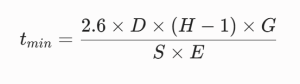
⚠️ Critical Catch: For an existing tank evaluation under API 653, the formula actually uses (H-1) instead of just H for the first course (where H is the height from the bottom of the shell course to the maximum design liquid level).
The “Why” Behind the 1-Foot Method
When a tank is filled with liquid, the outward hydrostatic pressure causes the cylindrical shell to expand radially. However, the very bottom of the first shell course is welded directly to the annular plate or tank bottom.
This bottom connection acts as a physical restraint, preventing the shell from expanding freely at the absolute bottom ($H$). Because of this localized stiffening effect, the maximum circumferential (hoop) stress does not actually occur at the bottom weld, but rather slightly above it. API standards determine that calculating the hydrostatic head at a point exactly 1 foot above the bottom of the course provides a safe, accurate approximation for the maximum hoop stress that course will experience.
2. Remaining Life (RL) Clarification
To find the remaining life, you must use the current/actual thickness (t current – t actual) and subtract the minimum allowable thickness (t min); use this formula:
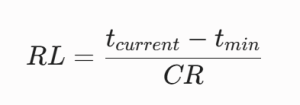
Using initial thickness would just tell you the total lifespan of the tank from the day it was built.
3. Stress Distribution
-
The stress actually decreases as you go up the tank because the liquid head (hydrostatic pressure) decreases. The bottom shell course experiences the highest stress, which is why it is the thickest.
🧠 Additional “Exam Traps” to Watch For
-
Repair: When calculating remaining life, if the tank’s next scheduled internal inspection interval is greater than the remaining life of the bottom, the tank must be repaired, altered, or taken out of service.
-
Specific Gravity (G): If the exam question mentions a chemical but says consider (water) for “hydrostatic test, then G = 1.0 (for water), regardless of what product the tank normally holds.
-
Dictated Intervals: While “Inspection Interval = Remaining Life /2” is the golden rule, remember that API 653 sets maximum caps (e.g., 5 years for external visual, 10 years for ultrasonic thickness measurements, and 20 years for internal inspections unless Risk-Based Inspection (RBI) dictates otherwise). If your RL/2 gives you 15 years for an external inspection, the answer is still capped at 5 years!
Your strategy of triaging questions (First, Second, and Third Pass) is exactly how you pass this exam. Trust your pacing, watch your units, and don’t let a single tough question drain your clock.
want to know more? study our free lessons and quiz at:
API 653 Storage Tank Inspector Online Training Course