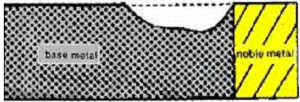
When two dissimilar materials are in contact with each other, there is a high possibility of one of them act as sacrificial anode and corrode. The one that corrodes looses electrode and turns positive or becomes anodic while the other material that is not affected by corrosion is in negative state or becomes cathodic. The corroded material looses electron while the other one gains electron.
To avoid corrosion, these materials shall be kept apart by some form of insulation such as rubber or coating .
For more protection, ensure that the material to be protected is in negative state electron wise. This is possible by injecting or impressing some constant source of current via a battery or source of electricity or attach a material to it that corrodes first. For example, aluminium chunk can be attached to carbon steel structure or pipeline. Here the aluminium sacrificing itself and corrodes first protecting the structure and pipeline and hence the name sacrificial anode.
For corrosion to happen, 3 elements needed, anode, cathode and a medium to connect them which can be moisture in the air or water. To stop corrosion, we could either coat the structure to be protect it while for added assurance make sure, it is always in negative state because corrosion is an electrochemical process.
want to know more? visit our training course , study our first mock exam and some 10 lessons for free:
API 571 Online Training Course – inspector-training.com