What you are expected to know for the API 1169 exam?
[/vc_column_text][vc_separator style=”shadow” border_width=”7″][/vc_column][/vc_row][vc_row][vc_column][vc_column_text]
API 1169 Pipeline Construction Inspectors is representing the client on new onshore pipeline construction. This means offshore pipeline and operation/maintenance of onshore pipeline is not in the scope.
[/vc_column_text][vc_separator style=”shadow” border_width=”7″][/vc_column][/vc_row][vc_row][vc_column][vc_column_text]
The API 1169 inspector is not only expected to supervise construction and testing of pipeline but also have knowledge about safety and environmental (pollution, contamination) issues that may happen during construction and testing of pipeline.
[/vc_column_text][vc_separator style=”shadow” border_width=”7″][/vc_column][/vc_row][vc_row][vc_column][vc_column_text]
You shall be examined based on the following topics:
- Pipeline Construction Inspection/Management Knowledge Areas (QA, Safety, Environment)
- Front-end Construction (Survey, Staking, ROW, Permits)
- Installation Construction (Stringing, bending, welding/NDE, trenching, crossing, coating, lowering, tie-in)
- Back-end Construction (Cathodic Protection, As-built, restoration, hydrostatic testing, pigging)
- Post-Construction (Line list close out, punch out, handover to operation)
[/vc_column_text][vc_separator style=”shadow” border_width=”7″][/vc_column][/vc_row][vc_row][vc_column][vc_column_text]
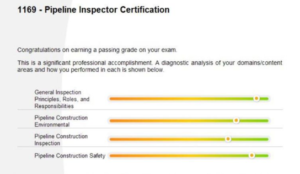
Typical score card showing areas of examination
[/vc_column_text][vc_separator style=”shadow” border_width=”7″][/vc_column][/vc_row][vc_row][vc_column][vc_column_text]
General Notes
A variety of experience gained for the past 20 years are acceptable. For example, if you have a BS degree and minimum of 2 years of experience in any area of pipeline inspection fields such as Utility Inspection, Pressure/Leak Testing, Welding Inspection, Coating Inspection, Safety Inspection, Offshore Pipeline Inspection, then, you are qualified to attend the exam. Other non-inspection activities and academic qualification or even no education acceptable but increases the minimum experience required to 5 years.
[/vc_column_text][vc_separator style=”shadow” border_width=”7″][/vc_column][/vc_row][vc_row][vc_column][vc_column_text]
- Initial exam and certification cost 580 $ and re-examination / rescheduling cost 200$. API 1169 certification is valid for a three-year term and recertification cost 435 $.
[/vc_column_text][vc_separator style=”shadow” border_width=”7″][/vc_column][/vc_row][vc_row][vc_column][vc_column_text]
- The API 1169 exam is 3 hours long and Questions for the examination are multiple-choice.
[/vc_column_text][vc_separator style=”shadow” border_width=”7″][/vc_column][/vc_row][vc_row][vc_column][vc_column_text]
- The exam has 115 questions, of which only 100 are scored. The remaining 15 are pre-test, which are not scored questions.
[/vc_column_text][vc_separator style=”shadow” border_width=”7″][/vc_column][/vc_row][vc_row][vc_column][vc_column_text]
- Paper, notes and reference materials are not allowed into the exam but you shall be given pen and paper at the Prometric test center upon request.
[/vc_column_text][vc_separator style=”shadow” border_width=”7″][/vc_column][/vc_row][vc_row][vc_column][vc_column_text]
- Page two of the Publications Effectivity Sheet lists the references (Safety and environmental protection documents) that will be available during the exam for open book questions. You shall have access to US safety and environmental documents as well as their Canadian counterpart. Open book exam questions will focus on only those areas where the technical content of US and Canadian documents overlaps. Search button is deactivated so you should know where to find answers. Recommend to flag off the open book questions and answer them at the end to better manage your time.
[/vc_column_text][vc_separator style=”shadow” border_width=”7″][/vc_column][/vc_row][vc_row][vc_column][vc_column_text]
- US and Canadian government-based reference materials will be provided to all the candidates during the exam on their computer monitors for some 15-20 open book questions.
[/vc_column_text][vc_separator style=”shadow” border_width=”7″][/vc_column][/vc_row][vc_row][vc_column][vc_column_text]
- Some open book questions may only be answered using US OSHA regulations (29 CFR 1910 and 29 CFR 1926). These questions are clearly identified in the exam and will say “according to OSHA” in order that applicants will know to use the OSHA regulations provided during the exam to answer these questions.
[/vc_column_text][vc_separator style=”shadow” border_width=”7″][/vc_column][/vc_row][vc_row][vc_column][vc_column_text]
- You cannot opt for remote proctoring while registering for exam. This means this exam is scheduled to be administered in-person at designated Prometric test centers only.
[/vc_column_text][vc_separator style=”shadow” border_width=”7″][/vc_column][/vc_row][vc_row][vc_column][vc_column_text]
- The exam windows for 2026 are: April 10 – May 1, 2026; August 7 – 28, 2026 and December 4 – 25, 2026. Application Deadlines are 9 weeks before the exam window. For example, for exam window April 10 – May 1, 2026; your application should have been received and approved by February 6, 2026.
[/vc_column_text][vc_separator style=”shadow” border_width=”7″][/vc_column][/vc_row][vc_row][vc_column][vc_column_text]
Publication Effectivity Sheet tells us which revision of documents to study while Body of Knowledge outlines which section of each document is relevant for exam.
[/vc_column_text][vc_separator style=”shadow” border_width=”7″][/vc_column][/vc_row][vc_row][vc_column][vc_column_text]
Study Materials
According to Publication Effectivity Sheet and Body of Knowledge, the following documents should be used for designing the open book part of the questions (Around 100 Questions):
- API 1169, Pipeline Construction Inspection (Entire document is subject to testing)
- API 1110, Pressure Testing of Steel Pipelines for the Transportation of Gas, Petroleum Gas, Hazardous Liquids, Highly Volatile Liquids, or Carbon Dioxide (Entire document is subject to testing with exception of the appendices)
- API Q1, Quality Management System Requirements for Organizations Providing Products for the Petroleum and Natural Gas Industry (sections 3, 4 &5)
- CGA (Common Ground Alliance) Best Practices (Entire document is subject to testing)
- INGAA, Construction Safety Guidelines (Entire document is subject to testing)
- API 1104, Welding of Pipeline and Related Facilities (sections 3 through 11)
[vc_separator style=”shadow” border_width=”7″]
API 1169 Online Training Course
Features
- Offering 48-hour money-back guarantee eliminates your risk, ensuring confidence in your investment.
[/vc_column_text][vc_separator style=”shadow” border_width=”7″][/vc_column][/vc_row][vc_row][vc_column][vc_column_text]
- With 6 months 24/7 course access, you have ample time for preparation. You can pass on your first attempt, or Free Renewal if needed, all at a fraction of traditional classroom costs.
[/vc_column_text][vc_separator style=”shadow” border_width=”7″][/vc_column][/vc_row][vc_row][vc_column][vc_column_text]
- Our students enjoy a 95.4% pass rate after completing the course.
[/vc_column_text][vc_separator style=”shadow” border_width=”7″][/vc_column][/vc_row][vc_row][vc_column][vc_column_text]
- Instructor support via
[/vc_column_text][vc_separator style=”shadow” border_width=”7″][/vc_column][/vc_row][vc_row][vc_column][vc_column_text]
- Our Online Training Course includes: Lessons, Slides, Videos & Animations and plenty of mock exam questions; allowing you to train on your spare time from anywhere on your laptop or phones, making learning convenient and at your own pace.
[/vc_column_text][vc_separator style=”shadow” border_width=”7″][/vc_column][/vc_row][vc_row][vc_column][vc_column_text]
API 1169 Pipeline Construction Inspector Online Training Course includes:
- 12 Hours of video clips
- 158 Lessons
- 1100 Slides
- 1750 Timed mock exam questions
[/vc_column_text][vc_separator style=”shadow” border_width=”7″][/vc_column][/vc_row][vc_row][vc_column][vc_column_text]
Click on link below to study our Free Lessons & Quiz
API 1169 Online Training Course
[/vc_column_text][vc_separator style=”shadow” border_width=”7″][/vc_column][/vc_row][vc_row][vc_column][vc_column_text]
[/vc_column_text][/vc_column][/vc_row]