Here’s a clear, exam-focused breakdown of API 653 concepts—this is what you actually need to understand (not just memorize) to pass.
🛢️ API 653 is about in-service inspection, repair, alteration, and reconstruction of storage tanks (especially those built to API 650 / API 12C).
Think: “Is this tank safe to keep operating—and what do we do if it isn’t?”
To succeed, you must stop viewing the exam as a “reading” challenge and start viewing it as a “decision-making” challenge.
1. The Core Philosophy: “Suitability for Service”
The primary objective of the API 653 inspector is to determine if a tank is safe to continue operating until the next scheduled inspection. Every core concept in the exam flows from this:
-
Data Integrity: Can you calculate precise corrosion rates?
-
Structural Thresholds: Can you determine if a corroded area or settlement pattern exceeds the specific “allowable” limits defined in the Annexes?
-
Repair Logic: Can you identify when a defect is a “repair” (restoring to original condition) versus an “alteration” (changing the design/configuration), and subsequently, which NDT methods and welding requirements apply?
2. Conceptual vs. Calculation Breakdown
Understand how the two exam sessions split these concepts:
Category |
What it Tests |
Strategy |
Conceptual |
The “Awareness” level—definitions, inspection intervals, safety rules, and “Shall/Should” requirements. |
Rely on active recall. If you have to look these up, you will run out of time. |
Calculation |
The “Application” level—corrosion rates, shell thickness, settlement, and weld sizes. |
Rely on procedure. Master the “formula → substitution → check units” flow. |
3. The “Big Three” High-Yield Areas
If you are struggling to prioritize, these three areas are the “heavy hitters” that appear on almost every exam:
-
Inspection Intervals (API 653 & 575): You must be able to calculate the next internal/external inspection date based on current condition, corrosion rates, and regulatory requirements. This is the “clock” that dictates tank safety.
-
Settlement Evaluation (API 653 Annex B): is a high-yield section of the exam. Because it involves complex geometry and specific interpretation, test writers often use it to create “multi-step” logic problems..
-
Welding & NDT (ASME IX & V): You aren’t being tested as a welder, but as a reviewer. You must be able to look at a WPS/PQR/WPQ package and identify if the variables are appropriate for the repair being authorized.
4. Key Exam Strategies to Remember
-
The “Unit Trap”: API is notorious for testing whether you catch unit mismatches (e.g., mixing inches/feet or imperial/metric). Before you ever solve a formula, look at the units in the prompt.
-
The “Pretest” Question: If you encounter a question that seems completely alien or uses terminology not found in your reference set, do not panic. It is likely a non-scored calibration question. Flag it, give it your best guess, and move on.
-
Search Engine Mastery: Since the exam is digital, your proficiency with
Ctrl+Fand keyword selection is just as important as your technical knowledge. If you search “Settlement,” you might get 200 hits; if you search “cosine fit,” you get exactly the section you need. Please note that search button is disabled during the exam.
5. Your “Inspector’s Mindset”
When you read a question, don’t ask, “What is the answer?” ask, “What is the code requiring me to do to ensure this tank doesn’t fail?”
-
When in doubt, be conservative. API standards are built on safety factors. If you are choosing between two options and one is “faster” but less precise, and the other is “slower” but more conservative, the code usually favors the latter.
🧠 1. BIG PICTURE (MOST IMPORTANT CONCEPT)
API 653 = Fitness for continued service
You are always answering:
- Is the tank safe?
- How long can it run?
- When do we inspect again?
- Do we repair or alter it?
📐 2. CORROSION & REMAINING LIFE (TOP SCORING AREA)
Same logic as API 510—but applied to tanks.
You must know:
- Corrosion rate
- Remaining life
- Next inspection interval
Key concept:
Tanks thin over time → you must predict failure before it happens
📏 3. MINIMUM THICKNESS (CRITICAL)
This is more important in API 653 than API 510
You must determine:
- Minimum required shell thickness
- Bottom plate thickness
- Annular ring thickness
Concept:
If thickness < minimum → action required (repair, replacement, or de-rate)
🛢️ 4. SHELL DESIGN & STRESS (API 650 LINK)
API 653 relies heavily on API 650 design rules.
You must understand:
- Hydrostatic pressure increases with height
- Bottom shell courses carry highest stress
- Stress varies along shell height
Key idea:
Lower shell = highest stress = highest failure risk
🌊 5. HYDROSTATIC HEAD (VERY IMPORTANT)
Same concept as API 510, but more critical here.
- Pressure increases with liquid height
- Used in shell stress calculations
Concept:
Taller liquid column = higher stress at bottom
🔍 6. INSPECTION TYPES (FREQUENT QUESTIONS)
You must know:
- External inspection
- Internal inspection
- On-stream inspection
Concept:
Different inspections detect different problems
⏳ 7. INSPECTION INTERVALS
Driven by:
- Corrosion rate
- Remaining life
- Tank condition
Key rule:
Interval ≤ remaining life (with limits)
🧱 8. TANK COMPONENTS (VERY COMMON)
Know each part and failure mode:
- Shell
- Roof
- Bottom
- Nozzles
- Annular ring
Concept:
Each component fails differently
🔥 9. DAMAGE MECHANISMS (API 571 + TANK SPECIFIC)
Common ones:
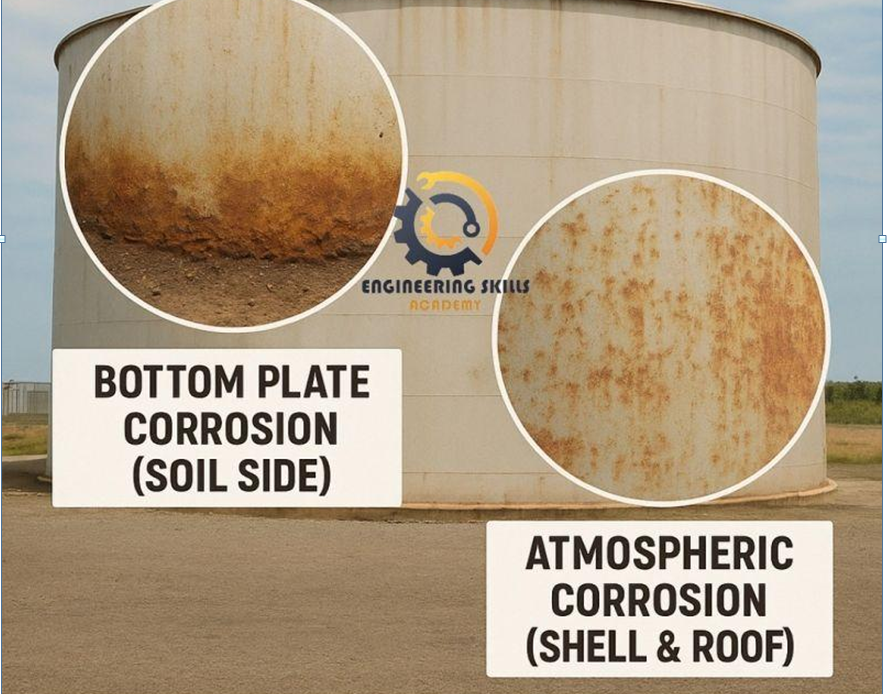
- Bottom corrosion (soil side)
- Pitting
- MIC (microbiologically influenced corrosion)
- Settlement damage
- Roof corrosion
Concept:
Environment + service = damage type
⚙️ 10. REPAIRS, ALTERATIONS & RECONSTRUCTION
You must distinguish:
- Repair → restore original condition
- Alteration → change design
- Reconstruction → rebuild tank
Concept:
Different rules and approvals apply
🧪 11. TANK SETTLEMENT (VERY IMPORTANT & UNIQUE)
This is API 653-specific and heavily tested
Types:
- Uniform settlement
- Edge settlement
- Tilt
Concept:
Uneven settlement → stress → failure risk
📘 12. CODE NAVIGATION (HUGE ADVANTAGE)
You must quickly find:
- Inspection requirements
- Thickness rules
- Repair criteria
- Settlement limits
Reality:
Many questions are OPEN BOOK speed tests
🧠 13. FITNESS-FOR-SERVICE THINKING
This is what the exam really tests:
Instead of formulas, think:
- Is it still safe?
- Can it continue operating?
- Does it need repair?
- Can we reduce fill height?
⚠️ COMMON EXAM TRAPS (API 653)
🚨 Trap 1:
Confusing remaining life vs inspection interval
🚨 Trap 2:
Ignoring bottom corrosion (most common failure)
🚨 Trap 3:
Forgetting hydrostatic pressure increases with height
🚨 Trap 4:
Mixing:
- Repair
- Alteration
- Reconstruction
🚨 Trap 5:
Ignoring settlement effects
🎯 HOW API 653 DIFFERS FROM API 510
API 510 |
API 653 |
Pressure vessels |
Storage tanks |
Internal pressure |
Hydrostatic pressure |
MAWP critical |
Thickness critical |
Weld efficiency |
Shell stress distribution |
Less settlement |
Settlement VERY important |
🧠 SIMPLE MEMORY MODEL (PASS THIS EXAM)
“Corrosion reduces thickness → thickness controls stress → stress controls safety → safety determines inspection & repair”
want to know more? study our free lessons and quiz at:
API 653 Storage Tank Inspector Online Training Course