Preparing for the API 510 Pressure Vessel Inspector Examination requires a strategic approach tailored to individual backgrounds and study habits. Here are some important points to enhance your efficiency in preparation:
- Time management is crucial. Instead of spending countless hours studying without direction, create an organized study plan. With 50-60 hours of focused study, you can achieve significant learning outcomes. Our online course provides 24/7 access and support, helping you concentrate on key subjects and high-scoring areas effectively.
- A structured 12-week study plan, dedicating 5-6 hours per week, allows for a consistent learning pace. This flexible approach lets you study at your convenience, enhancing productivity while fitting into your daily schedule.
- Avoid cramming the week before the exam. While you might pass, the knowledge gained will quickly fade. Use this preparation time to deepen your inspection knowledge and skills, which will significantly benefit your career.
- Maximize your study plan by subscribing to our online course, where the content depth aligns with the expected exam questions. You’ll learn about the concepts, codes, and recommended practices necessary for interpreting API exam questions effectively.
- The Publication Effectivity sheet outlines essential documents for your study. The Body of Knowledge provides insight into what you need to know and where to find it. Identify your weaker areas and focus on them in our training course, while also concentrating on high-scoring topics.
- Remember that studying the API 510 code must be thorough. Additionally, your study of ASME Sec. VIII Div.1, ASME Sec. IX, and ASME Sec. V should comprehensively cover the topics outlined in the Body of Knowledge.
By following these guidelines, you can enhance your preparation for the API 510 exam and position yourself for success.
Open and Closed Book Questions
Understanding the distinction between open-book and closed-book questions is crucial for effective exam preparation.
Open-book questions require candidates to refer to diagrams, formulas, tables, graphs, and curves from the Codes. These questions often involve calculations and are designed to assess your ability to locate information rather than memorize it. It’s essential to familiarize yourself with the Code Information, especially sections that are lengthy or descriptive, as you won’t be expected to recall this information but should know where to find it.
To prepare for open-book questions, practice navigating through reference codes and recommended practices (RPs). Highlighting important paragraphs, tabbing pages, and adding explanatory notes can save time during the exam. During mock exams, pay attention to frequently referenced code pages to understand where to locate answers.
In contrast, closed-book questions focus on general and specific practical scenarios that inspectors encounter daily. These questions test your knowledge without the aid of reference materials.
It’s important to allocate your study time wisely, focusing on topics that yield a higher number of exam questions. For instance, while some training institutes may dedicate excessive time to ASME VIII, the actual number of exam questions from this section may be limited. In the case of the API 510 exam, API 510 and API 572 are critical, with the former outlining dos and don’ts and the latter detailing inspection practices.
Our API 510 online training course is structured to cover the essential body of knowledge while emphasizing areas with a higher question yield, ensuring a focused and efficient study experience.
We recommend the following three phases of study for exam preparation:
- If you are about 1-2 months away from the exam date, read all the Codes at least once and focus on the highlighted text in the Codes.
- If you are about two weeks away from the exam, concentrate on the highlighted text as well as the mock examinations provided. Refer to our slides on Publication Effectivity Sheet Highlights (Module 13).
- In the last week of preparation, focus on Flash Cards and the highlighted text from the Codes and RP (Modules 13 & 14 of our training course).
Time Management during the Exam:
– Aim to complete the closed-book part of the exam (110 questions) within 2 to 2.5 hours, using the remaining 15-30 minutes to review any flagged questions. This means you should spend a maximum of 1.5 minutes per question, answering at least 40 questions per hour.
– The open-book part (60 questions) may take the full 3.75 hours allocated, depending on how quickly you can locate the relevant topics within the reference documents. Aim to spend a maximum of 3 minutes and 45 seconds per question, answering at least 16 questions per hour.
– Keep track of your time by monitoring the number of questions attempted and the time remaining on the top right corner of the screen during the exam.
Tip: During the open-book section, try not to spend more than 2 minutes searching for answers in the Codes and RPs. If it takes longer, flag the question and move on. You may find the information while answering other questions.
For the open-book part, aim to answer a minimum of 40 questions per hour.
Always keep an eye on the clock in the top right corner of the computer screen during the exam, which shows the remaining time versus the number of questions attempted. Completing each part 15-30 minutes early allows you to review flagged questions and ensure all questions are answered.
You may start from Question No.1 and proceed. If after 1 hour, you feel that you are maintaining the speed (40 questions per hour for closed book and 16 questions for open book), that is fine. If, however, you are behind the target progress rate, start jumping the questions, for example, start attempting those short questions that you can answer quicker. Flag off questions whose answer you do not know, to be reviewed at the end.
Then, at the end, start reviewing the flagged off or marked questions by clicking ‘’Review marked questions’’ tab and start solving them using your “feel” factor. Go on like this until say the last remaining 5-10 minutes.
If there are still some questions where you have no clue at all, just mark the answer at random. This may give you few lucky points.
Attempt all questions since there is no negative marking.
Before the clock stops, make absolutely sure that you have answered all the questions.
If you press the ‘’Review all’’ button, you can also see whether you have answered all the questions or not. The exam stops automatically once you ran out of time.
How Do I Prepare For Classroom Training?”
Note: This section is more suitable for those candidates who have opted for our blended course, that is, combined Online plus our 40 Hours virtual or face to face classroom training.
The API Body of Knowledge covers a broad spectrum of knowledge which many inspectors might not be exposed on a regular basis.
Our classroom course is intensive covering welding, NDT, WPS, Codes, damage mechanism, Inspection of pressure vessel and relief valves, explanation of important terms, exam tips and time management, as well as solving sample questions and Q & A sessions, all within approximately 40 hours.
So, we expect that you have gone through the online course well enough and have gained the minimum level of knowledge but with a few glitches. The aim is to bring the candidates into an acceptable level of knowledge, so he/she can pass the examination. You paid a lot of money, and we would also like high exam pass rates for the sake of our reputation and business.
Remember, nobody can become an inspector by just a few days of classroom training, but we believe, if you have studied the online lessons, then, 40 hours classroom training is enough to cover the topics and debug any doubts you may have.
The current online course is worth 50-60 hour of study depending on your past experience and knowledge. Solving the mock questions and exams can take another 20 hours.
Important tip: Analyse the areas of knowledge you are already competent and then make a list of your weak areas.
As long as your weak areas are not part of ‘’high scoring area’’, you are safe; otherwise, you need to build up your strength on those areas to an acceptable level.
We have meticulously crafted mock questions to align with your exam preparation, simulating a Timed API 510 exam environment. These questions are designed to enhance your understanding by dissecting the rationale behind correct answers and discerning why other options fall short.
Engaging with sample questions in this manner will fortify your exam readiness, helping to mitigate errors and navigate potential pitfalls. Each correct answer is elucidated, ensuring clarity and reinforcing your grasp of key concepts.
In your exam journey, prioritize selecting the “BEST” answer as per API standards. Even when faced with multiple seemingly correct choices, opt for the one that most effectively addresses the question at hand. Consistent engagement with our online training course material is paramount. Avoid last-minute cramming; regular study habits breed success and pave the way for smoother comprehension during classroom sessions, ultimately culminating in exam triumph.
Individual study approaches vary, so tailor your learning style to suit your strengths. Take note of challenging areas for discussion in class, leveraging our support to enhance your understanding. During classroom sessions, adhere to a focused and concise approach to maximize learning opportunities and respect your peers’ time and engagement. Our aim is to cover the curriculum comprehensively while fostering a conducive learning environment.
Feel free to reach out for assistance or share feedback at any stage of your learning journey, whether through the online platform or during classroom interactions. Your progress and comprehension are our top priorities. Embrace a study routine comprising brief, regular intervals over prolonged study marathons. Utilize our mobile platform for convenient on-the-go learning, ensuring flexibility in your study regime.
It’s important to note that about 50% of questions are derived from the inspection code (API 510) and inspection practice (API 572), while the remaining 50% marks cover additional material across approximately 2000 pages.
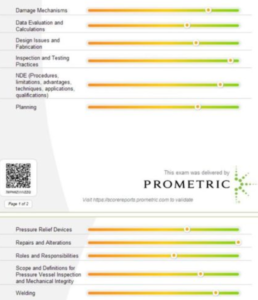
Have a look at a Typical API 510 Exam Score Card to see the broad areas you are examined against:
Study our our free lessons (modules 1 & 2 ) and try our free quiz (Click below and go to Curriculum);